Historical Context: Clinical Trials

Clinical trials can be traced back to biblical times. A military leader, King Nebuchadnezzar, assessed the health of people who followed a diet of legumes and water for 10 days in 500 BC. Although Nebuchadnezzar’s trial was not exactly a clinical trial, it is the earliest recorded time of a medical test guiding a decision about public health.
|
Ambroise Pare, a French barbon surgeon who served as a military surgeon since the year 1536, accidentally conducted the first clinical trial. Pare ran out of boiling oil which he had used to seal soldiers’ wounds, and instead turned to using egg yolk, turpentine, and oil of roses. The following day, Pare discovered that those whom he had applied “egg yolk, turpentine, and oil of roses” were in better condition than those who were treated with boiling oil. 5
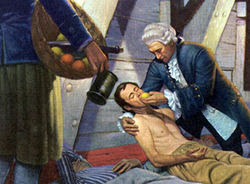
It is James Lind, however, who is the credited with being the first physician to conduct a controlled clinical trial in the modern era. Lind’s trial shows his awareness to the importance of maintaining factors constant such as “clinical condition, environment and basic diet”. Through Lind’s trial, Lind was able to promote remedies.5 7 In 1738, Lind joined the Royal Navy as a surgeon.7 In the ship - where Lind was a surgeon - there was a “high mortality” rate of the sailors due to scurvy. Scurvy is a disease resulting from a lack of vitamin C. Lind’s trial involved twelve sailors, and six treatments that Lind was testing. In Lind’s book, Treatise of the Scurvy, he described his trial: |
|
"...two were ordered each a quart of cider a day. Two others took twenty-five drops of elixir vitriol three times a day … Two others took two spoonfuls of vinegar three times a day … Two of the worst patients were put on a course of sea-water … Two others had each two oranges and one lemon given them every day … The two remaining patients, took … an electuary recommended by a hospital surgeon" -Treatise of the Scurvy
|

Like Lind, modern day physicians gather evidence, test their theories, inform health policy, and put their work to practice after the theory has been proved to be successful. But, there were flaws in Lind’s experiment such as not stating how the participants were chosen. Issues of controlled variables are something that modern day physicians take into account so as to improve the methods of approach to a clinical problem.
However, laws have been set into place regarding health policy and the methods of approach to clinical trials that might have led pharmaceutical companies and physicians to conduct trials in either developing countries, on minority people, or on people seen as having a debt to society such as prisoners--an act that is of more controversy that regards human rights rather than controlled variables.
Bhatt, Arun. "Evolution of Clinical Research: A History Before and Beyond James Lind."Perspectives in Clinical Research. Medknow Publications, 1 Jan. 2010. Web. 16 Mar. 2015. <http://www.ncbi.nlm.nih.gov/pmc/articles/PMC3149409/>.
"Science Museum. Brought to Life: Exploring the History of Medicine." Ambroise Paré (1510-90). Web. 16 Mar. 2015. <http://www.sciencemuseum.org.uk/broughttolife/people/ambroisepare.aspx>.
Milne I. “Who was James Lind, and what exactly did he achieve?”. JLL Bulletin: Commentaries on the history of treatment evaluation. (2012). Web. 16 Mar. 2015<http://jameslindlibrary.org/articles/who-was-james-lind-and-what-exactly-did-he-achieve/>
"Science Museum. Brought to Life: Exploring the History of Medicine." Ambroise Paré (1510-90). Web. 16 Mar. 2015. <http://www.sciencemuseum.org.uk/broughttolife/people/ambroisepare.aspx>.
Milne I. “Who was James Lind, and what exactly did he achieve?”. JLL Bulletin: Commentaries on the history of treatment evaluation. (2012). Web. 16 Mar. 2015<http://jameslindlibrary.org/articles/who-was-james-lind-and-what-exactly-did-he-achieve/>
